










How a Website Helps a Restaurant Grow: India 2026
A website helps a restaurant grow by giving it a channel it owns: a menu page Google can show, a place to take bookings or direct orders without an aggregator commission, and a way to keep returning customers instead of renting them from an app. It does not replace Zomato, Swiggy or your Google Business Profile — most restaurants should set up the free Google profile first, and build a simple site second, once regulars and repeat orders exist. Here is how a website helps a restaurant grow in practice, what each route costs in India in 2026, and the order to do things in.
How a website helps a restaurant grow: the four jobs it does
Four jobs do the paying; together they are the restaurant website benefits worth spending on.
A menu people can read on a phone
Most Indian traffic is a mid-range Android phone on a congested network, so your menu has to load fast and read easily on a small screen — the same rule we cover in our guide to a high-converting business website.
Direct orders and bookings without commission
On your own site, the per-order cost is the payment gateway: Razorpay charges 2% per successful domestic transaction plus 18% GST on the fee, so a ₹500 order costs ₹11.80. In July 2026 the president of the Bruhat Bengaluru Hotels Association (BBHA) put aggregator commissions at 8-28% of order value — ₹40 to ₹140 on that same order — though that is the association's figure, not a platform rate card.
Repeat customers and your own data
The NRAI complained to the CCI in July 2021 about "data masking" — restaurants not getting customer data from the platforms. A guest who books or orders on your site stays your customer.
Proof for catering, party and corporate enquiries
Someone planning an office lunch or a birthday wants your menu, a sense of prices and a number to call before they ring anyone. Measure calls and WhatsApp taps, not visits; Gigzman's builds, for instance, include GA4 events on form starts, form sends, calls and WhatsApp taps.
Do restaurants need a website if they are on Zomato and Swiggy?
Not on day one. Aggregators are discovery and delivery; if most of your orders are first-time app orders and you have no regulars yet, the app is doing its job.
The issues are rent and data. The NRAI told the CCI in July 2021 that platforms charged 25-35% of order value in 2020-21. BBHA's president said commissions range from 8-28%, and alleged that platforms add deep discounts without prior approval and charge for ads without explicit consent. Treat these as association statements in an ongoing dispute, not as rate cards.
The website starts paying when repeat guests exist — people who would order again anyway — because each repeat order on your own channel saves that order's commission. One caution: check your aggregator partner agreement before steering app customers toward direct ordering.
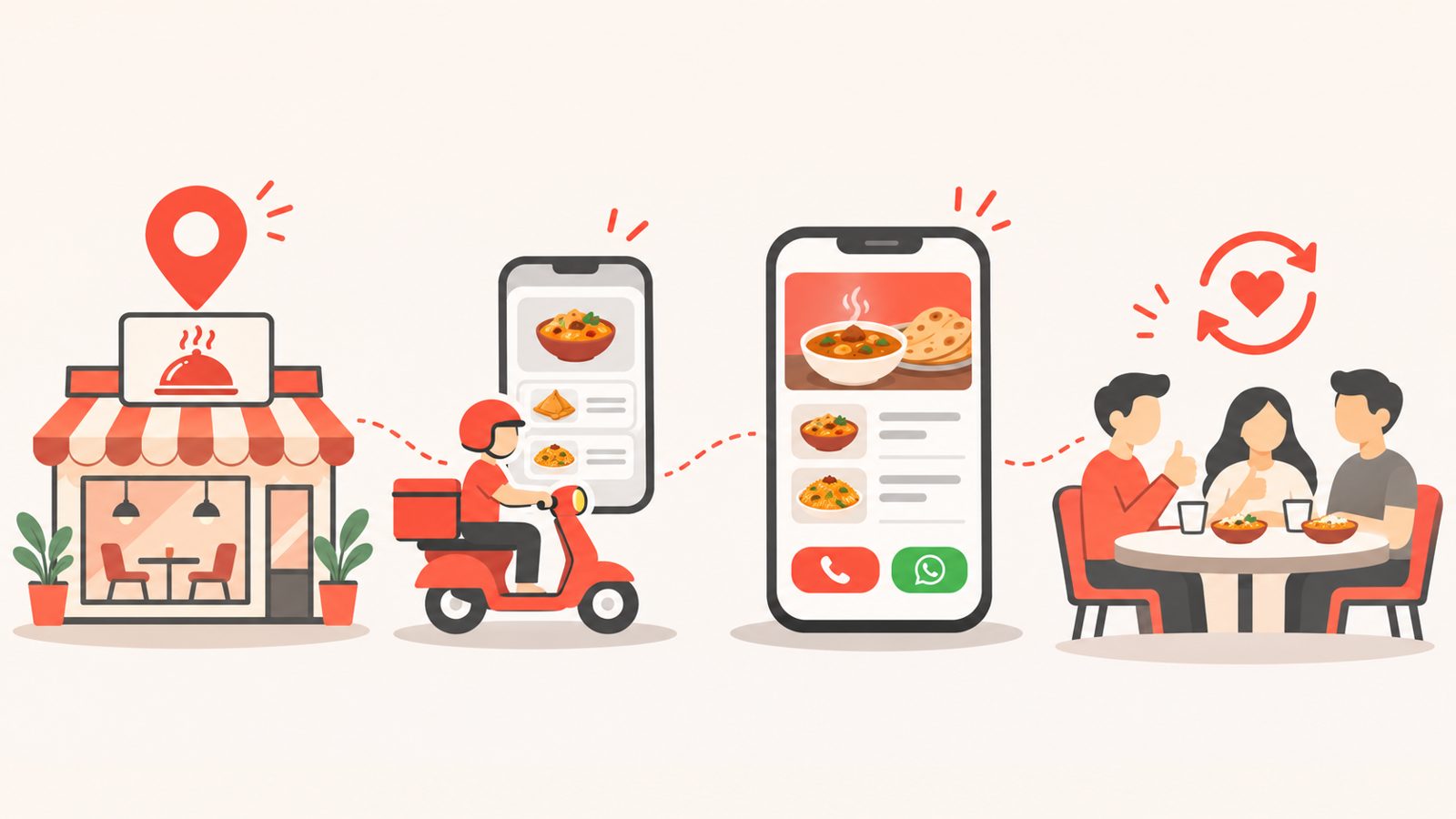 AI-generated illustration.
Your options compared, from free to custom
| Option | What it costs | Good for | Where it falls short |
|---|---|---|---|
| Google Business Profile only | Free | Being found on Search and Maps; bookings and waitlist via Reserve with Google | A profile, not a site you own; Google lists ordering providers for Australia, Canada, Germany, Japan, UK and US — not India, when checked on 15 Nov 2026 |
| Zomato/Swiggy listing | Commission per order; BBHA quotes 8-28% | Discovery and delivery | Per-order commission; customer data stays with the platform (NRAI complaint) |
| DIY builder like Wix | Free plan; own domain and removing Wix branding need Premium; payments on higher plans; prices vary by location | A cheap menu-and-photos site | Costs your time; speed and SEO depend on how you set it up |
| QR/ordering tool like DotPe or similar POS-linked tools | No public pricing — demo or callback | In-store scan-order-pay; POS syncs in-store and online in one dashboard | Serves guests already inside; does not get you found |
| Freelancer | Varies — no reliable average | Small custom jobs | After-launch support is on you to check |
| Agency, e.g. Gigzman | From ₹45,000, typically 3-6 weeks | A fast custom site with technical SEO and enquiry tracking built in | More than a new outlet needs |
Google Business Profile is the free starting point: hours, photos, menu, offers, review replies, and table booking or waitlist via Reserve with Google. Google's restaurant page for Business Profile shows what you can add.
Aggregators are a marketing channel with a per-order cost; read your own agreement, since the public commission figures come from industry associations, not the platforms.
A DIY builder works if you have more time than money: Wix's free plan is real, but your own domain and removed branding need a Premium plan, and payments need a higher plan.
A QR/ordering tool like DotPe digitises the table — scan, order, pay, one dashboard syncing in-store and online — with pricing only via a demo or callback. It does not get you found on Google.
A freelancer costs less than an agency for a small site; ask upfront who fixes things after launch.
An agency is the most expensive route, and only sometimes the right one. Gigzman starts at ₹45,000 and typically takes 3-6 weeks, with sitemap and wireframes agreed first and copy written together with you. If you only need a menu page, that is more than necessary — Gigzman is one option, not the default.
What a restaurant online ordering website actually needs
However you build it, the checklist is short:
- A menu page that loads fast on 4G — most guests are on mid-range Android phones on congested networks. (Gigzman ships Next.js pages as plain HTML for this reason.)
- One-tap Call, WhatsApp and Order buttons.
- Realistic payment costs: around 2% + GST per successful domestic transaction — ₹11.80 on a ₹500 order — plus a domain at ₹800-₹1,500 a year and hosting at ₹0-₹2,000 a month.
- Hours and address that match your Google profile exactly.
- Tracking on the actions that pay: GA4 events on form starts and sends, calls and WhatsApp taps, so you measure enquiries, not visits.
For the conversion side of this checklist, see our guide to a high-converting business website.
When it is too early for a website
If the outlet is new and reviews are few, put the first months into the free Google profile — photos, menu, offers, and replies to every review. If you need something on your own domain quickly, a single landing page — menu, hours, location, WhatsApp button — is a smaller, cheaper engagement than a full site. And skip integrations for now: payments, CRM and booking systems are each their own project, with their own cost.
A sensible order to do it in
- Set up your Google Business Profile — free; hours, photos, menu, offers, review replies.
- Use aggregators if delivery fits your margins, knowing the commission range restaurant associations quote.
- Launch a simple site: menu, photos, hours, and Call/WhatsApp/booking buttons.
- Add direct ordering once repeat orders justify it — the gateway's ~2% + GST per transaction beats the commissions above on every repeat order.
- Add CRM or booking integrations only when a real need shows up — each is a separate project.
If you decide on the custom route, Gigzman's website development service starts at ₹45,000, typically runs 3-6 weeks, and includes 30 days of post-launch fixes. I'm Tarun, founder of Gigzman, so weigh what I say about agencies accordingly.
Questions people ask
Do restaurants need a website if they are on Zomato and Swiggy?
Not at first — aggregators handle discovery and delivery. The case for a website grows once you have regulars: direct orders avoid the 8-28% commission BBHA's president quoted in 2026, and the guest's details stay with you — NRAI has complained to the CCI about platforms' "data masking".
How much does a restaurant website cost in India?
DIY can be free on Wix's free plan, but your own domain, removed Wix branding and payment acceptance all need paid plans, and prices vary by location. An agency build starts from ₹45,000 at Gigzman, and starting prices are floors, not averages. Running costs: domain ₹800-₹1,500 a year, hosting ₹0-₹2,000 a month, and a payment gateway at roughly 2% + GST per transaction.
Can Google Business Profile take orders in India?
Check your own profile. Google's restaurant-profile FAQ lists online-ordering providers on profiles in Australia, Canada, Germany, Japan, the UK and the US — India was not in that list when we checked on 15 November 2026. Where ordering is available, owners can choose a preferred partner or disable it. Separately, Reserve with Google lets customers book a table or join a waitlist from your profile.
Is a QR menu the same as a website?
No. A QR tool like DotPe serves guests already inside your restaurant — scan, order, pay, with the POS syncing in-store and online orders in one dashboard. A website is for being found on Google and booked by people who have not walked in yet.
Tell us what you are working with and we will come back with a plan.