












Ecommerce Website Builder or Custom Build? How to Pick (2026)
If your store is a standard catalogue with a normal checkout, pick an ecommerce website builder such as Shopify: payments, tax and shipping are already solved, and the Basic plan starts at ₹1,499 a month billed yearly. Go custom only when your pricing logic, integrations or buyer flow are things the builder cannot express — which is roughly where B2B starts. And if you do not yet know whether the product sells at all, build neither: sell on a marketplace or through an Instagram link first, and commission a store once demand is proven.
The Shopify vs custom website debate usually turns into a long feature comparison that helps nobody decide. This article is a decision test instead: six questions, the four limits where builders stop working, honest 2026 costs in ₹, and a middle path if you are genuinely unsure.
The quick test: builder or custom?
Read down the left column. The first row that describes your situation is usually where the decision settles.
| If this is true… | Choose |
|---|---|
| You are still testing whether anyone will buy | Neither — sell on a marketplace or via an Instagram link first |
| Standard retail or D2C catalogue, normal checkout | A builder — Shopify Basic from ₹1,499/mo billed yearly |
| Products need more than three options or more than 2,048 variants | Custom, or first test whether a builder app covers it |
| The checkout steps themselves must change | Shopify Plus (from ₹1,75,000/mo) or a custom build |
| B2B pricing: customer groups, quantity breaks, quote requests | Custom |
| Deep ERP or CRM integration, especially with undocumented systems | Custom — and budget the integration as its own project |
If every row pointed you to a builder, the rest of this article is mostly confirmation: start on the cheapest plan that fits and put your energy into the products. If two or more rows pointed to custom, read the next three sections closely before you talk to anyone. And if you are a retail or D2C brand sitting exactly on the line, see our retail and D2C page.
What an ecommerce website builder gives you on day one
An ecommerce website builder is a rented shop that is already fitted out. On Shopify, the plumbing a from-scratch build has to create — payments, tax and shipping — is solved when you sign up. You add products, choose a theme, connect a payment method, and you can take orders.
The costs are monthly and predictable. As of 2026, Shopify's India pricing is: Basic at ₹1,499 a month billed yearly, with a 2% fee on transactions through third-party payment providers; Grow at ₹5,599 a month with a 1% fee; and Plus from ₹1,75,000 a month. Note the per-order fee, not just the subscription: at ₹75,000 a month in sales through a third-party gateway, Basic's 2% fee is ₹1,500 — already as much as the plan itself.
WooCommerce (woocommerce.com) works differently. It is open source: the software is a free download with no monthly platform fee, but hosting and any paid extensions are separate costs you arrange yourself, so more of the plumbing is your job — and for the purposes of this decision, it still counts as assembling a shop from pre-made parts rather than writing one.
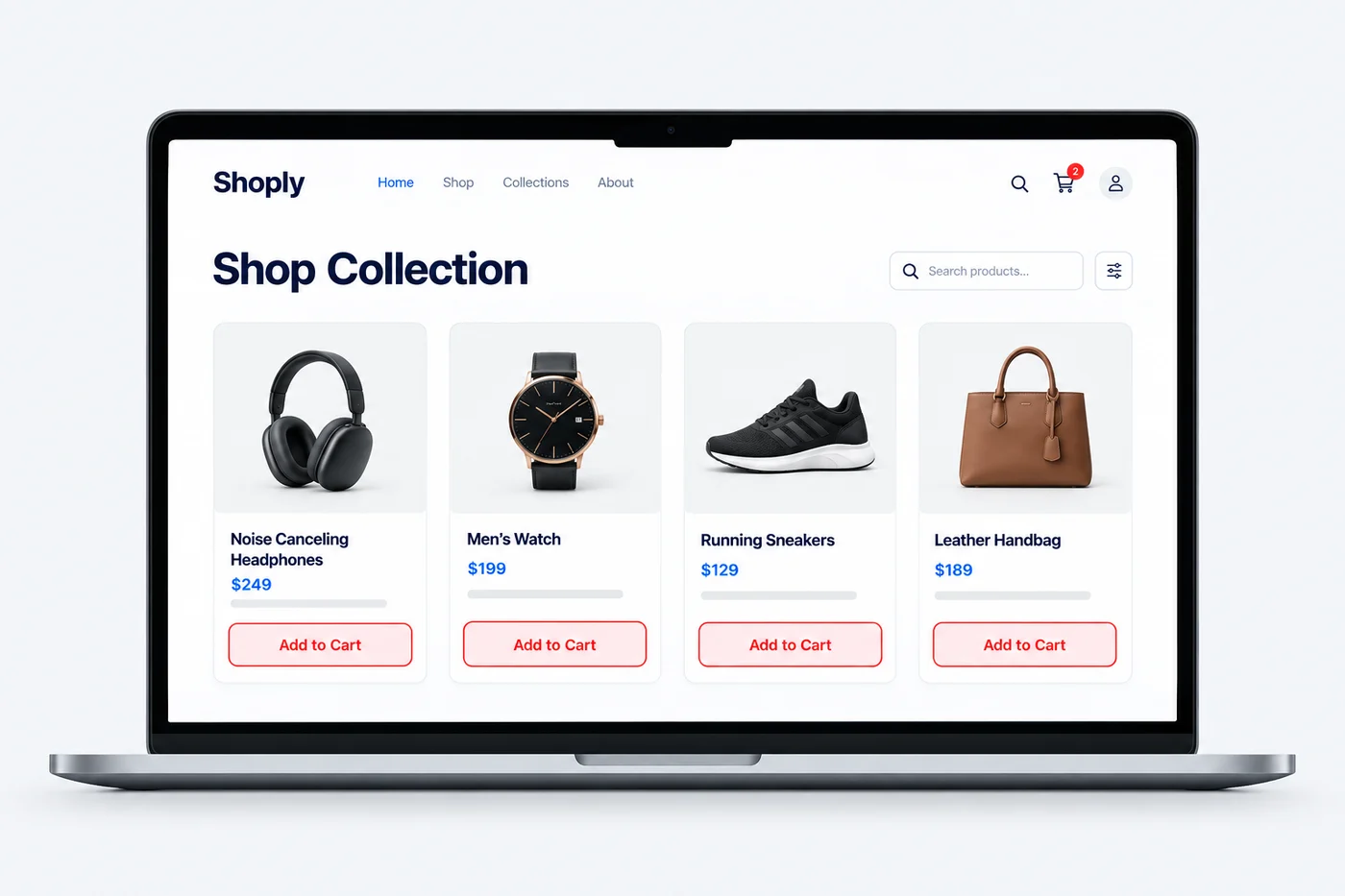
 AI-generated illustration.
Where builders run out: four limits to check before you commit
Builders fail in predictable places. Check these four against your catalogue before you commit to a platform.
1. Variants and options
Shopify allows up to 2,048 variants per product and up to three options per product — size, colour and material, for example (Shopify's variants documentation). A catalogue whose products vary by up to three things fits inside that. If you sell something like made-to-order furniture with fabric, finish, size and leg style — four options — you are already past the limit, so check for an app that handles it or plan for custom.
2. Checkout
Standard checkout customizations are available on Basic and higher, but advanced checkout customization is only available on Plus, which starts at ₹1,75,000 a month (Shopify's checkout extensibility documentation). If your buyer flow depends on changing the checkout itself — adding steps, removing steps, replacing payment with a quote request — the honest choices are an expensive plan or a custom build.
3. Integrations
Every integration — payments, CRM, ERP, booking — is its own project, and the undocumented ones are the expensive ones. A builder's app store covers the common cases well. If your business runs on an older ERP or a custom internal tool with no documentation, assume that connection will need custom work whoever builds the store, and price it separately.
4. Pricing logic
The clearest custom signal is pricing. When your pricing logic, integrations or buyer flow cannot be expressed in the builder, you have reached roughly where B2B starts. Quantity breaks, customer-group pricing and quote requests are the classic examples. If different customers should see different prices, or the price depends on quantity slabs, test the builder against those exact rules before committing.
When a custom ecommerce website is worth it
A custom ecommerce website is worth the money when the four limits above are your everyday reality: B2B pricing with customer groups and quantity breaks, quote requests instead of a fixed-price checkout, or a buyer flow no template anticipates.
On cost: Gigzman's eCommerce builds start at ₹85,000 and typically take 5–10 weeks. Treat both numbers as a floor, not an average — prices are floors, and each integration you add (payments, CRM, ERP, booking) is scoped as its own project, with undocumented systems the expensive ones. Our pricing page shows how these floors are structured.
After launch, an optional maintenance retainer of ₹8,000–₹35,000 a month covers upkeep. A custom store has no platform looking after it, so someone has to own updates, fixes and small changes. Budget for that from day one rather than discovering it in month three.
Cost compared: builder vs custom in the first year
Here is the website builder vs custom website comparison by cost type. We are deliberately not giving totals, because a total written without your catalogue size and integration list would be made up.
| Cost type | Builder (Shopify) | Custom build |
|---|---|---|
| Subscription | ₹1,499/mo (Basic, billed yearly); ₹5,599/mo (Grow); from ₹1,75,000/mo (Plus) | No platform subscription |
| Per-order fee | 2% on Basic and 1% on Grow with third-party payment providers | No platform fee; the payment gateway still charges about 2% + GST per transaction |
| Build cost | Your own setup time | From ₹85,000; typically 5–10 weeks; floors, not averages |
| Upkeep | The monthly plan keeps running | Hosting you pay for directly, plus an optional maintenance retainer, ₹8,000–₹35,000/mo |
For the itemised version — the cost lines a proper quote should contain — read our guide to ecommerce website development cost in India.
The middle path: builder now, custom pieces later
The choice is not permanent, and treating it as permanent makes owners overbuy. A sensible path for many stores: launch on Shopify now, because payments, tax and shipping are solved on day one. Learn what your buyers actually do. If you hit one of the four limits — really hit it, not imagine it — that is when custom earns its cost.
Moving later does not mean starting over. A proper migration carries over products, variants, customers, orders and URL redirects. Gigzman builds on Shopify as well as custom stores on Next.js, so the same team can handle both halves of that journey.
The bottom line
If the test pointed you to a builder, start small and put your budget into the products. If it pointed to custom, get a scoped quote before you commit to anything.
I'm Tarun, founder of Gigzman. We build both Shopify and custom stores, so we have no reason to push you to one.
If the test above pointed you to custom — or left you genuinely unsure — talk to us about your store. Bring your catalogue shape, your integration list and your pricing rules, and we will tell you which side of the line you are on.
Questions people ask
Is Shopify a website builder?
Yes — specifically a hosted ecommerce website builder built for selling. Payments, tax and shipping are already solved when you sign up, and India plans start at ₹1,499 a month billed yearly.
Can I move from a builder to a custom store later?
Yes. Migration covers products, variants, customers, orders and URL redirects, so your catalogue, customer records and order history come with you.
Is WooCommerce a custom website?
Not quite. WooCommerce is open source and a free download with no monthly platform fee, but hosting and paid extensions are separate costs. You arrange hosting and extensions yourself, but you are still assembling a store from pre-built parts rather than commissioning code written for your business.
Which is better for SEO — a builder or a custom site?
Be cautious of anyone who promises that one ranks better; that is a claim we cannot support with evidence here. What we can say: if you migrate platforms later, URL redirects are part of the migration, and they protect the search traffic you have already built. Make this decision on fit and cost, not on SEO promises.
Tell us what you are working with and we will come back with a plan.