










Google Play Console Developer Account: What to Do
Quick answer: Declare trader status in your Google Play Console developer account (required from November 2026) and finish developer verification before it goes global in 2027; then audit your app against the 29 October 2026 policy update.
Google Play is trending in India today (15 November 2026), with rising searches for Play Console developer accounts. Separately, the Supreme Court is hearing developers' challenge to Google Play's payment terms; the next hearing is on 1 December 2026, and the current User Choice Billing option and fees apply today. If fixing your app turns into a rebuild, see our guide to mobile app development cost in India.
Key terms
- Trader status: a declaration Google now requires in Play Console from November 2026.
- Android developer verification: Google's check that ties each app to a verified developer, rolled out to all developers in Play Console and the Android Developer Console from 30 March 2026.
- User Choice Billing: the India option, since January 2023, to offer alternative billing alongside Google's.
What changed on Google Play
Between March and November 2026 Google rolled out developer verification, made app registration mandatory in four countries, published a policy update and added a trader-status declaration, while the Supreme Court took up the billing challenge. The dates:
- 30 March 2026 — Google began rolling out Android developer verification to all developers in Play Console and the new Android Developer Console.
- 30 September 2026 — Apps must be registered by verified developers to install or update on certified Android devices in Brazil, Indonesia, Singapore and Thailand. Google says this expands globally in 2027; India is not in the first group.
- 29 October 2026 — A policy announcement gave developers "at least 30 days from October 29, 2026" to update apps.
- November 2026 — "Starting in November 2026, you must declare your trader status in Play Console".
- 3 November 2026 — The Supreme Court heard app developers, including Matrimony.com, challenge Google Play's payment terms; the next hearing is on 1 December 2026.
- 1 December 2026 — If you sell into or out of Japan, complete authorization by this date or payments are held globally.
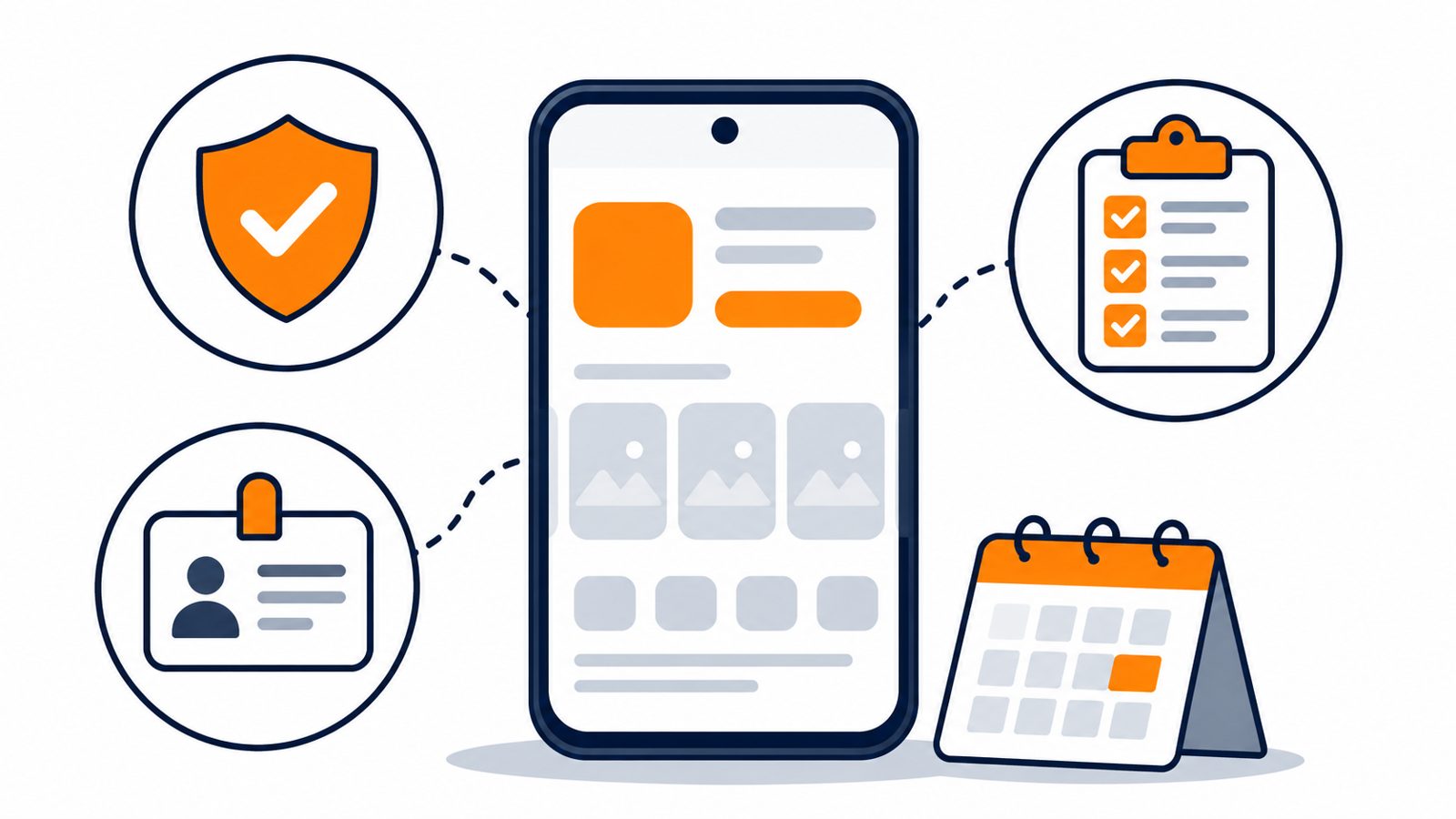
AI-generated illustration.
Check your Google Play Console developer account
If an agency or freelancer published your app, check whose account it sits under. Your Google Play Console developer account should be in your business's name, and opening one costs a one-time US$25 registration fee, so there is little reason to leave ownership with a third party.
Then handle two account-level tasks:
- Declare trader status. Per the Play Console help announcement, this is required from November 2026.
- Check the verification status page. If you have completed Play Console developer verification, Google registers eligible Play apps automatically; only in the rare case it cannot, you follow the manual app claim process.
Android developer verification before the global rollout
For businesses searching "android developer verification india": India is not in the first group. The registration requirement currently applies in Brazil, Indonesia, Singapore and Thailand, and Google says it will expand this globally in 2027. Once verification is complete, Google registers your eligible Play apps automatically.
If you distribute apps outside Google Play — a field-sales app shared as an APK from your website, or an app on another store — those can be registered in the Android Developer Console, or in Play Console if you also have a Play account. Google's stated reason for the registration push: its analysis found over 90 times more malware from sideloaded sources than on Google Play.
Audit your app against the October policy update
The 29 October announcement gave developers at least 30 days from 29 October 2026 to update apps. For the new contacts and subscription-discount policies, that means no earlier than 28 November 2026; the location, READ_CALL_LOG and app-quality items have their own dates in the table below. Here is that Google Play policy update, item by item:
| Change | Who it affects | Deadline |
|---|---|---|
| Apps targeting Android 17 (API 37+) must use the Android location button for one-time or infrequent location requests | Apps that request location | Mandatory from 27 January 2027 |
| Phone-call account verification is no longer a permitted use of READ_CALL_LOG; Google suggests the SMS User Consent API | Apps that verify accounts via call logs | 27 January 2027 |
| Subscriptions with eligibility-based discounts (for example, student plans) must clearly disclose eligibility criteria, the verification process and the pricing and benefit changes after eligibility ends | Apps offering discounted subscription plans | At least 30 days from 29 October 2026 |
| The manage-contacts permission is restricted to apps that need it for core functionality when system pickers are insufficient; those apps must submit a Play Console declaration, and others must use narrowly scoped platform intents | Apps that request broad contacts access | At least 30 days from 29 October 2026 |
| New app quality (memory and code optimization) requirements | All apps | February 2027 |
Separately, Google lists Play Age Signals, for age-appropriate experiences, as launching globally for all developers; the announcement sets no compliance date for it.
If this audit turns up work you need to budget for, our guide to mobile app development cost in India covers the main cost drivers.
Google Play billing in India: what the Supreme Court case means for you
MediaNama reported on 4 November 2026 that a day earlier, a Supreme Court bench of Justices PS Narasimha and Alok Aradhe heard app developers including Matrimony.com challenge Google's Play payment terms. The bench asked, "Can you opt out of the payment system in your contract?" The next hearing is on 1 December 2026.
The hearing has not changed the current terms. Google Play User Choice Billing in India has been available since January 2023: you can offer alternative billing alongside Google's, and Google charges 4 percentage points less on alternative systems — 11% to 26% via alternative billing versus 15% to 30% via Google Play billing, per MediaNama. Base payment decisions on the current terms, not on the case's possible outcome; note the 1 December hearing date and review after any ruling.
A quick checklist
- Confirm the Play Console account is in your business's name; a new developer account is a one-time US$25.
- Declare your trader status in Play Console.
- Check developer verification; once it is complete, Google registers eligible Play apps automatically.
- List every APK you distribute outside Play and plan its registration in the Android Developer Console.
- Walk your app through the policy table above; note 27 January 2027 (location, READ_CALL_LOG) and February 2027 (app quality).
- Selling into or out of Japan? Complete authorization by 1 December 2026.
- Base billing decisions on today's terms; recheck after the 1 December 2026 hearing.
Sources: Google Play policy announcement, 29 October 2026, Android Developers Blog on developer verification, Help Net Security on the 2027 global rollout, MediaNama on the Supreme Court billing hearing.
I'm Tarun, founder of Gigzman — we build Android and iOS apps for Indian businesses.
Questions people ask
Is Android's verified-developer requirement live in India?
Not yet. From 30 September 2026 it applies in Brazil, Indonesia, Singapore and Thailand; Google says it will expand globally in 2027, and India is not in the first group.
Our agency published our app under their Play Console account. What now?
Open an account in your business's name — the registration fee is a one-time US$25 — ask the agency to move the app into it, and complete developer verification so Google can register your eligible Play apps automatically.
Does the Supreme Court case change what we pay Google Play?
Not so far: the hearing on 3 November did not change the terms, and the next hearing is on 1 December 2026. Today, User Choice Billing works as it has since January 2023: 11% to 26% via alternative billing systems versus 15% to 30% via Google Play billing.
Tell us what you are working with and we will come back with a plan.