












Live Gold Rate Pricing for Jewellery Websites
Quick answer: Price = net gold weight × today's rate for that purity + making charge + stone value, then 3% GST on the total. Refresh after each benchmark update and lock the price at checkout.
Live gold rate pricing means every product price is computed from today's rate instead of typed in. Refresh the rate on a schedule, show the rate and its timestamp on the product page, and lock the price for a short window once the customer reaches checkout. This week shows why: on 12 Nov 2026 around 10:13 IST, MCX gold fell Rs 940 (0.7%) to Rs 1,38,778 per 10 g. A hard-coded price list goes stale within a day.
Terms used here:
- MCX: an Indian commodity exchange; its gold and silver quotes are futures contract prices.
- IBJA benchmark: the India Bullion and Jewellers Association's published reference rate for gold and silver.
- Board rate: the rate a jeweller sets for the day and displays in store.
- Making charge: the jeweller's charge for crafting the piece, on top of metal value.
- HUID: the 6-digit hallmark ID that gold jewellery must carry when sold.
What happened to gold and silver prices this week
On 12 Nov 2026 around 10:13 IST, MCX gold fell Rs 940 (0.7%) to Rs 1,38,778 per 10 g, according to Goodreturns. MCX silver fell Rs 2,275 (1.23%) to about Rs 1,82,250 per kg the same morning. India TV reported the MCX December gold contract touched an intraday low of Rs 1,38,399 that day, and December silver futures touched an intraday low of Rs 1,81,751, down 1.50%. The reason cited was hotter US inflation data and a US dollar at a 19-month high near 103, which raised expectations of Fed tightening.
MCX quotes are futures prices, not the retail rate in your showroom, and this article does not predict where gold goes next. The point: your pricing must handle moves in either direction without manual edits.
The live gold rate pricing formula
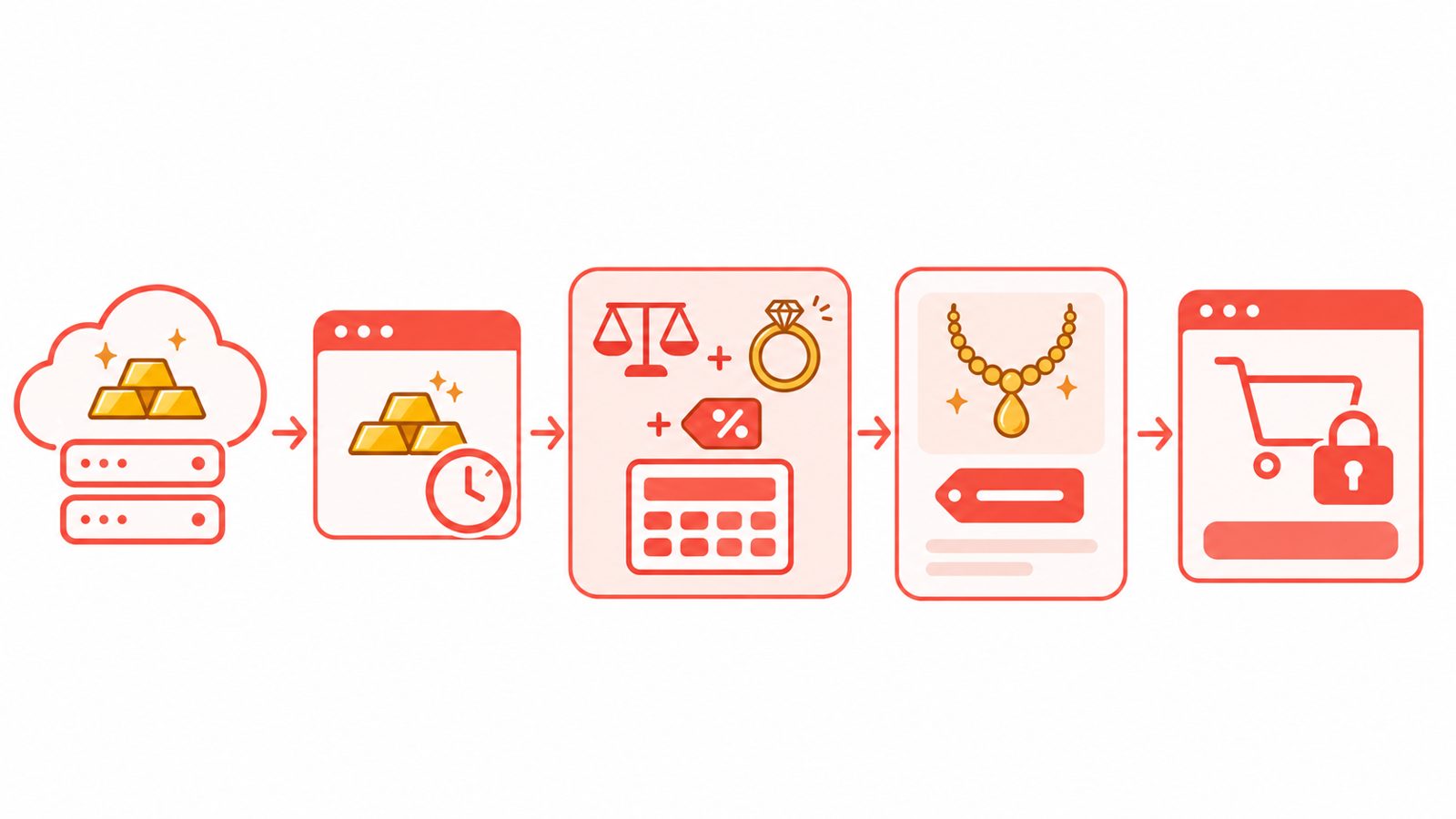 AI-generated illustration.
For each SKU:
Price = (net gold weight in g × rate per g for that purity) + making charge + stone value, then + 3% GST on that total
The making charge can be per gram, a percentage of metal value, or a flat amount — store which type it is on each product. If your rate source is the IBJA benchmark, note that those rates include import duty and customs but exclude GST, so adding GST is your job.
Worked example with a round number chosen for easy maths (not a current rate): a 10 g item, rate Rs 10,000 per g for its purity, making charge of one-tenth of metal value, no stones.
- Metal value: 10 × 10,000 = Rs 1,00,000
- Making charge: Rs 10,000
- Subtotal: Rs 1,10,000
- GST at 3%: Rs 3,300
- Final price: Rs 1,13,300
A common mistake on the making charges GST question: charging 5% on making charges in a retail sale. The 5% rate applies to a registered job worker's job charges (manufacturing), not the retail sale. In a retail sale, 3% applies to the full transaction value.
Where the rate comes from: choosing a feed
Default to the IBJA benchmark; use a vendor API if you need machine-readable updates, or your own board rate if you set one each morning. The three options:
- IBJA benchmark. The India Bullion and Jewellers Association polls its rates twice a day, in a 11:40–11:50 AM window and a 4:40–4:50 PM window. The rates include import duty and customs but exclude GST. IBJA works out the 999 price from its 995 auction, and other purities from the 999 price. It is also the reference RBI uses to issue and redeem sovereign gold bonds.
- An exchange or data-vendor gold price API. A vendor API gives machine-readable rates on a schedule, which suits automation. Check what the quoted rate actually represents — spot, futures, or a derived benchmark — before wiring it into pricing.
- Your own board rate. The owner sets a board rate each morning, for example from the benchmark plus the store's own adjustment. This works as long as it is entered daily and stored the same way as a feed.
Whichever you choose: keep a manual override for days the feed is down or clearly wrong, and store the source and timestamp with every computed price, so support staff can answer "which rate did this order use?"
Price-lock, caching and checkout
Store one rate set, compute prices from it at render time, reject outlier ticks, and snapshot the price into the order at checkout. With an IBJA feed, refresh after each of the two daily polls, in the 11:40–11:50 AM and 4:40–4:50 PM windows. Four rules for a jewellery ecommerce website:
- Cache the rate once. Store the current rate set in one place — a rates table or a key-value cache — and compute product prices at render time from it. Do not store final prices on each product row; that is how stale prices happen.
- Refresh after each feed update. When a new rate set arrives and passes checks, replace the cached set. Pages rendered after that moment show the new prices.
- Sanity-check new rates. Reject an incoming rate that moves more than a set percentage from the last one, and alert a human. One bad feed tick should not reprice the whole catalogue.
- Lock the price at checkout. When a customer reaches checkout, snapshot the rate and the computed price into the order and hold it for a fixed window — a window you choose to fit your payment flow. If the window expires before payment, recompute the price and show the customer the change before they pay. Never charge a different amount than the one displayed.
Product data you need before any of this works
The formula only works if the catalogue data exists. Per SKU you need:
- Gross weight
- Net gold weight (gross minus stones and non-gold parts)
- Purity (karat and fineness mark)
- Making-charge type (per gram, percentage, or flat) and value
- Stone details and value
- HUID
Since 31 March 2023, gold jewellery cannot be sold without a 6-digit HUID. Show the HUID on the product page and on the invoice.
If you want this built into your store, Gigzman's ecommerce development team can scope it. For budgeting, see our guide to ecommerce website development cost in India; we build for retail and D2C brands.
I'm Tarun, founder of Gigzman.
Questions people ask
Should the website price follow MCX live?
No. MCX quotes are futures contracts, not a retail spot rate. Use a spot benchmark or your own board rate; the IBJA benchmark, for example, is polled twice a day in fixed windows.
Is GST on making charges 3% or 5%?
In a retail sale to a consumer, GST is 3% of the total transaction value, whether making charges are shown separately or not. The 5% rate applies to a registered job worker's job charges in manufacturing, not the retail sale.
Tell us what you are working with and we will come back with a plan.